

This could’ve been an email
- Lyana Cuebas
- Nov 5, 2025
- 13 min read
No day spent at this university is a good day. It’s always too humid outside and sterile inside, like the place was designed to make you uncomfortable. If the general vibe of the university wasn’t enough to make me want to sleep in, the morning itself almost convinces me to turn back.
My black hair has already formed an alliance with the humidity. I tie it up to keep it out of the way, but even in a bun, it escapes and takes a life of its own. Four hours of sleep, caffeine, nicotine, and sheer spite fuel me as I drag myself toward the Social Science Department. A 7:30 a.m. philosophy class after an all-nighter is, simply put, the academic equivalent of nails on a chalkboard.
And if that wasn’t enough reason for my foul mood, I have to meet Sarah, lead investigator on the project I’m working on. She never schedules in-person meetings; our only interactions are her clipped emails demanding more test runs or progress reports.

The moment I step inside the classroom, I visibly gag at the overly sweet smell that clings to the room. It smells like an overpriced candle. I sit near the door, sign attendance, and slip out quietly. I can’t focus on Socrates or Plato when that email lingers in my mind.
I don’t usually skip class but, technically, it’s not skipping since I signed attendance and intend on coming back.
Down at the lobby, I almost pass Clover. She’s standing by the old elevator. I barely glance to the side, but I know it’s her—the frantic curls, the way she shifts her weight like she’s trying not to be seen. I haven’t seen her in years. For a split second, I can almost feel my mother’s hand tightening on my shoulder, warning me to keep my distance.
She looks different from her eight-year-old self—older, smaller somehow, tired in a way that makes my chest tighten. I can’t help thinking about those moments when she’d drift off mid-sentence, how the “episodes,” as her mother called them, started getting worse. I wonder if she’s better now.
Would she be touched if she knew I’ve spent the last two years working on research meant to cure people like her? The thought reminds me of where I’m heading. My stomach sinks. I need to see Sarah. I don’t have time for childhood nostalgia. The sooner I---
I pause. She still scrunches her eyebrows when she feels anxious. That same expression she had when we were supposed to be carefree still clings to her soft features. I curse myself as something in me softens.
There’s a trick to it, I think as she fumbles with the elevator button. Her honey-brown eyes meet my dark ones for a second—wide, uncertain—and I tap the down button for her. The moment feels too fragile for words. I try to make small talk anyway, and she gives a breathy, nonsense answer that makes the corner of my mouth lift before I can stop it.
As I turn toward the exit, I mentally check off my one good deed of the day.
Outside the building, the heat clings to my fair skin. I start the walk to the Biology building taking the longest route I know. The sidewalk runs along the avenue, with barely any trees for shade, so I end up hopscotching between the few scraps of shade like it’s a game I didn’t agree to play.
Before you ask—No, I don’t care if I look like a child. It’s so early, everyone’s either sleeping in or drooling through their 7 a.m. class. I suddenly acknowledge I’m sweating, and I’m not sure if it's the sun beating against my back, my ridiculous jumping or the nerves.
Normally, I walk fast—long legs, sharp stride, get-out-of-my-way energy— but today I feel like a lamb to the slaughter. My bag keeps sliding off my shoulder, and I keep tugging it back up, over and over, like a nervous tic.
The physics building becomes my savior, giving me shade until I’m a few steps away from the stairs of the pedestrian bridge. They’re wet, from last night’s rain. The steam that rises from them makes me cringe back, but even skin-melting steam is not enough to steer my mind away from her. Sarah wants to speak in person today—an event as rare as it is unsettling.
Geez, I sound like I'm marching to my death.
The parking lot’s already starting to fill, cars sliding into every open spot like a slow-moving tide. Engines hum, door slam, people run to their classes. Everyone’s rushing somewhere while I'm just trying not to think about where I'm headed. My head fills with questions.
What could she possibly want to say that requires seeing me in person? I know I keep saying it, but I need to make it as clear as possible: this woman has more pressing matters than speaking to me. My anxiety grows, my muscles clench. Maybe something went wrong with the formulation. Maybe I missed something. Whatever it is, I'm certain she’ll chew me up and spit me back out.
I make it inside the spacious lobby. Usually, the tables are filled with students, be it studying, socializing or pretending to be productive. Right now? This lobby is a ghost town. Maybe they’re scared of the lion that roams the hall.
As I pass by the offices, I try to distract myself by reading the nameplates on the doors of professors and fellow researchers—each a small, plastic rectangle with a black background and white letters printed in the cheapest, most generic font.
I adjust my pace, forcing one foot in front of the other. Let’s rip the band-aid, I tell myself, but my steps feel heavier as I get closer to her office. Dr. Villanueva is engraved on an elegant metal plaque, much nicer than the rest, and something tells me it’s not just because she’s the head of the Research Department.
My hand freezes just before I set the new world record for the softest knock. “Come in,” she says. My breath catches in my throat as I open the door, making sure it clicks softly behind me. As I step inside, I’m staggered by the lack of personality in her office. It’s minimalistic—almost pathologically so. No family photos, no color, just degrees and awards.
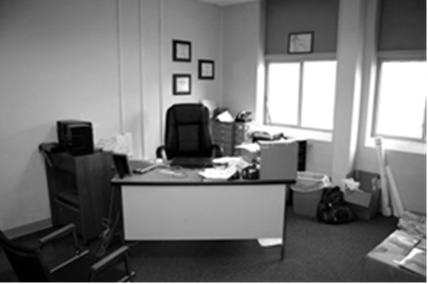
Sarah sits behind her desk, her monitor angled to the side, taking up most of the workspace. She’s typing away. I can hear the rapid clatter of her keys echoing in the quiet room. I can’t tell if her keyboard is every ASMR enthusiast’s wet dream or just annoyingly loud, and honestly, I don’t know where that line is drawn.
The sound of her typing is sharp, almost too hostile for how still she sits. Her back is straight, shoulders squared, posture perfect. She doesn’t greet me, and I don’t dare speak first. I stand in front of her, my hands behind my back, hiding the fact that I can’t stop picking at my nails. I don’t think I’ve ever really looked at her before. Honestly, it’s eerie—like staring into a distorted mirror of my future.

Her slick bun to my wild hair, her red bottoms to my boots, gold to my silver, polish to exhaustion. The similarities between us are uncanny. If she sees them…she must see the obvious differences—my chipped nail polish or my mismatched socks.
If she sees all of it, does she want to reprogram me? Strip what’s left of me and swap them for traits she values more? Like a new Sims character she can customize. From the color of my eyes to my core personality. Swap out kindness for indifference, honesty for ambition, love for manipulation, music for science.
I take a small step closer, the floor creaking faintly beneath my boots. “How are your classes?” Her voice, simulating interest, pulls me back. Her eyes flicker briefly to mine, sharp and assessing, but still she’s typing.
“It's going well. I’m taking philosophy with Dr. Madlock,” I say, trying to sound casual. “You know—the one doing that Neuroadaptive Response Mapping Initiative.”
“Ah, that’s nice,” she says, not looking up. I think this is the closest we’ve come to having a full conversation. There’s a pause. Her fingers hovered above the keyboard, the sudden silence making me freeze. She tilts her head slightly, like a predator looking at its prey. I wish I could hide behind a curtain, just like her office window. Who, I can clearly tell, is equally as stressed.
“I noticed your last batch readings were off.”
I stiffen, but years around Sarah has taught me that poker faces are essential. Give her an opening, and she will pounce.
“Oh—yes. It was the reagent. Expired. I’ve already ordered a new one. Once it arrives, I’ll repeat the run.”
She nods once, barely glancing at me, then resumes typing.
“Good. Keep monitoring it. You know we need the next batch perfect for testing.”
Perfect. The word sinks heavy in my chest. To everyone else, I might seem close—but to her, I’m never enough. Still, I feel the pull to reach it, even as every bone in my body screams to stop. My ears twitch as soon as she stops typing again.
“Using microencapsulation for your formulation—that’s clever. It keeps the active compounds stable, releases them gradually. Keep that method. But remember—precision matters above all.”
Precision. Another weight drops in my stomach, like stones settling in a lake. She says precision but all I hear is: Be more like me. My blood runs cold at the thought.
She exhales annoyed, then reaches for her phone and starts texting someone. “Oh—before I forget,” she says, her tone indifferent and calculating. “The Behavioral Engineering Society is hosting a fundraiser next Friday. Each lab will present their work.”
I nod slowly, unsure where this is going.
“I’ve decided you’ll be presenting our work,” she adds, finally glancing at me. “It’ll be good exposure.”
I blink. “Me?”
She gives a faint nod. “You’ve been assisting long enough. It’s time the Society knows your name, not just your last name. You’ll do fine.”
Fine. Another word that sits heavy on my chest. It’s not meant to reassure me. It’s meant to challenge me.
“Right,” I say, too fast. On paper, it sounds good—exposure, recognition. It feels like a chain around my neck, tightening with every syllable. I’ll stand there smiling, my name on a slide next to hers. Pretending I’m proud of what I’m doing. Pretending I’m hers.
Her eyes flicker up for a second, their intensity forcing me to look away. I feel the heat rise in my cheeks. Damn it. She probably saw that.
“Confidence is part of the presentation,” she says simply, returning to her phone.
“Who’ll be there?”
“Everyone who matters,” she answers. “Department heads. Donors. The Society’s review and admissions board.”
My throat tightens. The air in her office feels too synthetic—sterile, suffocating. I clutch the strap of my bag a little tighter, jaw aching from how hard I’m holding it in. Why do I feel like crying?
“Was that all?” I ask, keeping my tone as even as possible.
“Yes.”
She’s already looking back at her computer screen. No goodbye. No acknowledgment. Just dismissal adorned with indifference.
I hesitate at the door. Anger flickers—small, sharp, impossible to contain.
“You know,” I say, “this could’ve been an email.”
I don’t expect her to respond as I turn to leave, but she does.
“Samira, don’t wait for me at dinner. I have a paper I need to finish.”
I don’t answer. I couldn’t if I tried. Frustration hits like a lump in my throat. The door clicks shut behind me, but the sound still echoes in my chest. I don’t know why I still care. Maybe because ‘Perfect & Precise’ was drilled into me long before I knew what it meant.
The thoughts get too loud. They rattle around inside my skull until I can’t tell which are mine and which are hers. I walked faster through the corridor than I did coming in, each step echoing off the bone white walls. By the time I cross the lobby, I’m already digging through my bag for a cigarette.
And before you say they’ll kill you, I’m aware. I fear that might be the point. Plus, my mother hates the smell.

They don’t stop the shaking in my hands or the bounce in my leg, but they do make me feel like I’ve surfaced—just for a second—right before drowning again. The way the smoke burns my lungs feels like a campfire crackling in the dark. I move the silver headphones that hang from my neck over my ears and, with shaking fingers, crank the volume.
'La Secta Allstar' floods my head, drowning out Sarah’s voice and every word she left lodged somewhere behind my eardrums. I stayed there for a while. Long enough that my back feels fused with the concrete, and for the music blaring in my ears to sound like static.
By the time I peeled myself off the wall, the day had already slipped through my fingers. Between blurred hours, there are emails, half-eaten meals, and classes. Somewhere around my eighth cigarette break, the sun sinks without warning. I sit on a bench at the highest point of the university. It’s surrounded by three old, rustic buildings, the kind that seem to bleed history from their walls.
At the center, wrapped by a circular rotonda—demanding attention—is a relic of the past: a single concrete arch carved with intricate designs. It was built to commemorate the University’s first building. A symbol of legacy and promise. I scoff, as I search my bag for a lighter.

The bench faces the arch, and whoever designed it must’ve had the sunset in mind, because the sun aligns perfectly with it. It’s hard to ignore, and harder to look away. I have a fresh cigarette between my fingers. The evening air feels fresh against my skin. The sun is now a soft ember compared to its blazing self this morning.
I wonder if it ever had a choice—or if being the bringer of warmth and keeper of the day was just thrust upon it.
My phone vibrates in my pocket, a message reads: Sound check at 8. Suddenly there’s a pep in my step. I stubbed out the cigarette and tossed it into a trashcan.
My phone buzzes again with a new notification from a group chat called 'Suck it and See'. The message says: We’re on at Off the Wall. Be ready @ 7, Samira.
I roll my eyes as a small smirk escapes my lips. I tuck my phone into my pocket, settle my headphones over my ears, hit play and start walking, feeling the breeze shift.
The air feels different now, less oppressive, as though the sun’s retreat carries a bit of permission to shed the day.
As I move with the mass of students leaving the university, my thoughts drift home. My mother. My father. The names Roque and Villanueva, to everyone, might as well be personality traits.

My mother, filled to the brim with ego, selfishness, and ambition—built like a lab instrument, calibrated for success. By twenty-three, she was on Forbes “30 Under 30,” collecting research sponsors like trophies. My father, another hungry overachiever, shamelessly chasing the illusion of significance. Two lives crossing at Red Ivy University, in the right labs, perfectly complementary research—yet perfectly indifferent to love.
By the time I was born, they had both been nominated for a Nobel Prize. Sarah lost and let’s just say her resentment has a slower decay than any isotope known to man. Still, they remained bound by an unbreakable intellectual connection. Once their doctorates were finished, Sarah became head of the research department at Red Ivy and my father at a leading neuroscience institute in San Juan.
Love was never a pillar in our house, convenience was. My parents were divorced in practice: separate homes, cars, bank accounts. But to the public, they were still married. Somewhere along the way, the names Roque and Villanueva became more important as a pair than as individuals.
I shake my head, trying to loosen the echo of their legacy. I raise the volume of my headphones until the music drowns out the weight of perfection and expectation clinging to me like a second skin.
-----
Once my house is at an eye distance, I fumble through a jangling mess of keys— a set that looks like a janitor’s paradise. There’s the brass house key, the silver lab key, and a worn guitar pick tied with a string I’ve had since freshman year of high school.
The whole neighborhood knows I’m home as my keys jingle while I unlock the door. I’m welcomed by the familiar sound of silence. I take a deep breath, ignoring the spotless floors, pristine tables and how it all aligns perfectly like someone had measured it with a ruler. The air smells faintly of polish, and it hums order. I race up the exaggerated flight of stairs to my room.
Once I enter it looks exactly how I left it—chaos with personality. Clothes spill out of my comically large desk chair; empty coffee cups sit beside study reviews, holding the reason for my lack of sleep. My electric guitar leans against the bed, waiting for me to remember who I am when no one’s grading me. Band posters peel at the corners, revealing strips of the original white wall beneath the lilac paint. Notebooks are stacked with half-finished lyrics and countless mass balance analyses. They clutter the shelves, where strings of fairy lights loop haphazardly around them.
I’m smiling from ear to ear as I dig through the pile of clothes I refuse to fold. Clean, I swear— but folded? Never. Usually, I grab the first thing that catches my eye and call it a day. But tonight? Tonight, I go all out: black leather, big silver jewelry, boots worn just enough to make no sound on stage. As I hastily pull out the hair tie, my hair tumbles free, black waves framing my face without pattern. Suddenly a car honks, and I know who’s behind the wheel as I hear a familiar jingle.
I rub eye-shadow with my index finger and add glitter on the inner corner. I look at myself one more time, face scrunching in excitement an unfamiliar grin—not because I see them in me, but because I don’t. I grab my guitar and hurriedly rush out of my room. The door slams behind me, the echo reminding me that Sarah’s not here, a constant I never complain about.
Out of sight. Out of mind.
When I step outside, the chill air should make me shiver, but the rush in my chest beats it back. Mayagüez is one of those places where it has to rain at least an hour a day. It must’ve stopped while I was getting ready—that would explain the chill breeze. The sidewalk glistens, streetlights bouncing off puddles. My boots slap against the wet asphalt as I hurry toward the van.
I shouldn’t be as excited as I am to get inside. The closer I get, the stronger the smell—stale beer, smoke, and cheap air freshener fighting a losing battle.
I slide the side door open, and a wall of sound hits me—laughter, guitar strings, drumsticks clattering against metal, Lorena’s half-yelled, “¡Al fin!” She grabs my wrist and pulls me inside. The door thuds shut.
The van is a mess of tangled cables, snack wrappers, and “organized” sound equipment. Lorena sits next to me, her feet barely brushing the floor. She’s small, five feet at most, but built like she could punch a hole through the bass drum if she tried.
“Cuidado, puede ser que le haya dado un RedBull,” Alanis, the band’s bassist, says from the passenger seat, adjusting her eyeliner in the side mirror.
I wedge myself between Lorena and the mountain of equipment. The vinyl seat sticks to my legs. For the first time all day, I can breathe. The van jolts forward, heading toward the venue.
Laughter lives here, bright and untamed. It catches somewhere in my chest, tugging at an old memory.
The first memory I have of laughing this hard was around when I was seven. My mother used to drag me to her meetings—long hours in white rooms that smelled like coffee and pumpkin spice. Clover was always there too, sitting quietly beside her mother.
We weren’t supposed to talk. I knew that much, even back then—the way my mother’s hand would tighten on my shoulder whenever I glanced at Clover’s way. She didn’t have to say it out loud: she’s not like you.
But the moment the adults got lost in their discussions, we’d sneak out barefoot, slipping through the cold stone hallway so our steps wouldn’t echo. Clover would grab my hand and lead me toward one of the old ballroom—a forgotten room filled with old furniture and a sunroof that spilled sunlight across the floor like a spotlight. Here there were no masks, just kids.
She taught me that not every game needed rules—that pretending could be its own kind of freedom.
She’d point to the light and whisper, “We’re famous now,” handing me a stick from the floor like it was a microphone. Then she’d sing—off-key, loud, unhinged. I’d follow her lead, pretending the dusty furniture was an audience.
Eventually, we’d hear our mothers calling, their voices echoing through the tunnel behind us, dragging us back to the real world. And then, one day, Clover just… stopped coming. I waited by the old ballroom, barefoot on the sun-warmed floor, hoping she’d appear with that mischievous grin. But she didn’t. Maybe her episodes had gotten worse, or maybe life had pulled her in a different direction.
Sometimes, I still hear her laugh—sharp and bubbling, like soda fizz. I wonder if she finds comfort in these memories or if I’m the only one reheating them like leftovers.
Luis, our band’s main vocalist, suddenly shouts my name from the driver’s seat, startling me. “Samira! Where have you been, loca?” He says in his best Jacob Black impression.
I grin. “I was summoned by Scar,” I say theatrically.
“Long live the lion king!” Lorena yells, and the whole van breaks into chaotic applause. I laugh too, though for a split second, the implication settles heavy in my chest.
The van jolts forward. Luis yells over the music, Lorena drums on the seat backs, and Alanis passes me a half-empty bag of off-brand chips. For a second, it almost feels like nothing has changed—like I never saw Clover standing by the elevator, like next week isn’t waiting for me at all.

The band’s laughter fades into a hum at the back of my mind. I catch my reflection in the window—eyes rimmed with exhaustion no matter how much makeup tries to hide it, hair frizzing out of control, that same restless ache purring in my chest. The city slides by in streaks of light.
We stop at a red light.
Graffiti on a rusted electrical box catches my eye:
ARE YOU WHO YOU WANT TO BE?
The paint is cracked, bleeding from years of weather, but the words persist, gnawing at a thin, stubborn layer of resignation. I ignore the feeling.

Comments